#273 May Blue
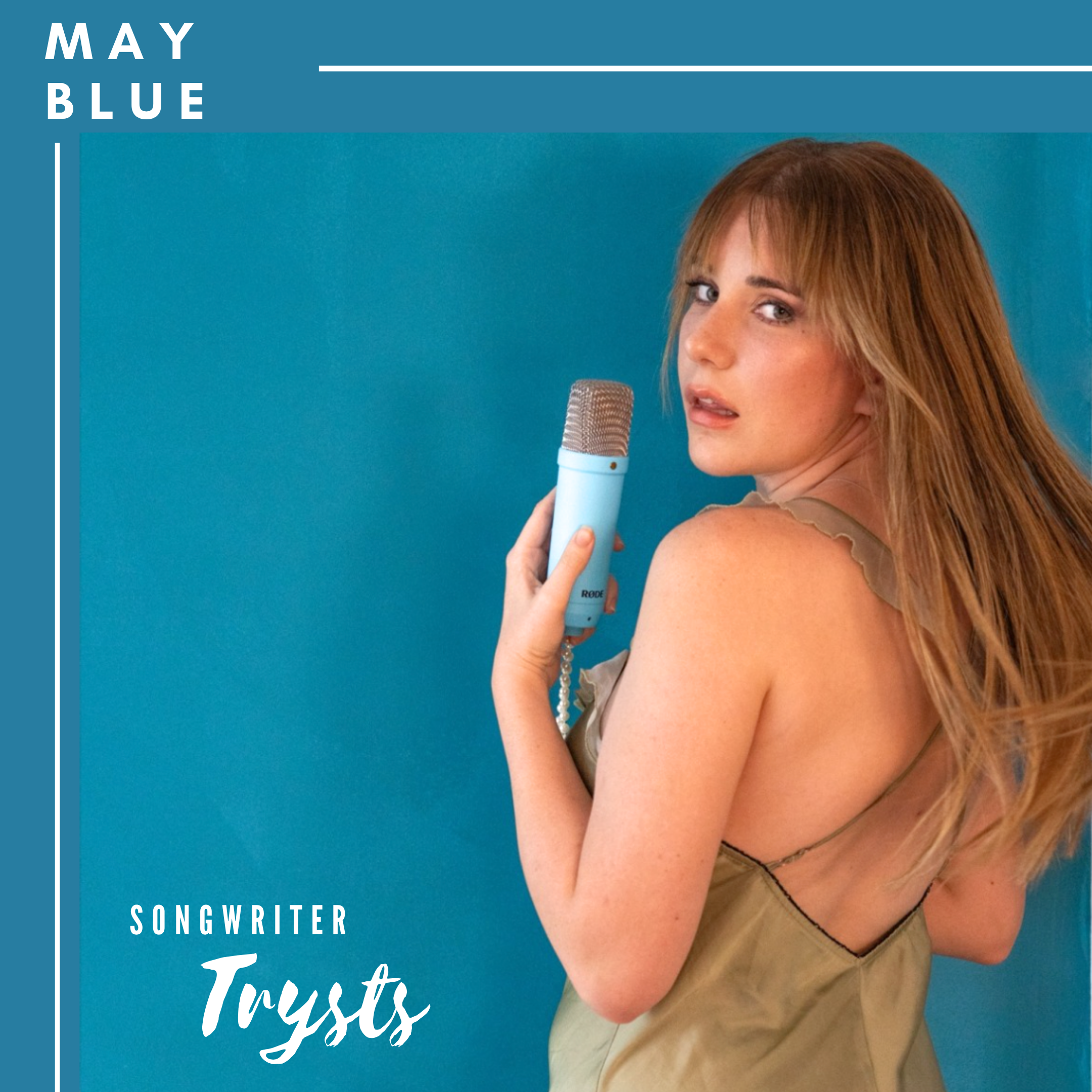
May Blue: Finding Her Voice, From Ghostwriter to Independent Artist
In this episode of Songwriter Trysts, we’re joined by the wonderful May Blue, a talented Australian singer-songwriter from the Hunter Valley in New South Wales.
With her distinctive jazzy and soulful sound, May Blue is carving out her own space in the Australian independent music scene. Her journey is a powerful reminder that sometimes finding your voice means having the courage to step away from the role you’ve always played and finally put your own story into the world.
For almost a decade, May worked as a ghostwriter, writing behind the scenes while helping bring other people’s stories to life. But after facing a major health scare, she began to re-evaluate what she wanted from her own creative life.
That experience became a turning point.
May found the courage to step out from behind the scenes, embrace her identity as an artist, and begin writing, recording and releasing her own original music.
From Ghostwriter to Recording Artist
May’s transition into releasing her own music wasn’t an overnight decision. It has been a journey of dedication, creativity and plenty of hard work.
After spending a month in Los Angeles and dedicating two years to working full-time on her music, May finally released her long-awaited album — and we think it was absolutely worth the wait.
Her music is already gaining recognition, with May making her way to the ARIA Awards and becoming part of the Recording Academy Class of 2026.
It’s an exciting chapter for an independent Australian artist who has spent so much of her career helping other artists tell their stories.
A Conversation About Songwriting, Courage & Finding Your Own Voice
In this episode, we talk about May’s songwriting journey, her experience as a ghostwriter, the decision to become an independent recording artist, and what it takes to commit to your own music.
For songwriters and independent artists, May’s story is particularly inspiring. There can be a huge difference between writing songs for others and putting your own name, voice and identity behind the music.
May Blue has taken that leap — and we can’t wait to see where it leads.
Whether you’re an Australian songwriter, singer-songwriter, independent artist, music lover or simply someone who loves hearing the stories behind original music, we hope you enjoy this conversation.
Listen to the full episode of Songwriter Trysts with May Blue and discover the artist behind the music.
And once you’ve listened, make sure you follow May and support her music. We’re excited to see what comes next for May Blue, both in the studio and on the live stage.
Connect With May Blue
Spotify
Listen to May Blue on Spotify
Instagram
Follow May Blue on Instagram
Facebook
Follow May Blue on Facebook
YouTube
Watch May Blue on YouTube
Transcript
Rae Leigh: Welcome to another Songwriter Tryst with May Blue. And you're in Sydney, aren't you?
May Blue: I'm in the Hunter Valley.
Rae Leigh: The Hunter Valley. Beautiful. Want to start by getting you as the artist, introduce yourself, tell us a bit about who you are and where you come from,
May Blue: yeah, definitely. I was a ghost songwriter for close to a decade.
Absolutely loved and hated it at the same time. Then in 2024, I had a bit of a health scare, and other than the thought of leaving my young children behind, which was terrifying for me, the saddest thing for me was that I'd never pursued my dream career of being a music artist.
And so I decided that if that was something I got better from, that was something I was going to go all in on. And after my second surgery, I got the all clear, and I just dove headfirst into my music artist career. I've been recording a lot internationally. I did a lot of recording in LA and New York for this first album that I've just released.
Yeah. But home for me is the Hunter Valley [00:01:00] in regional Australia.
Rae Leigh: Nice. And I love Australia. We're a big, we're an Australian-based podcast, but we do talk to artists all over the world. Some- but I love it when I get to speak to other Australian artists because I really wanna showcase to the world that we have some incredible talent here.
Even though we're small and dinky and forgettable when it comes to the music industry. When I go to conferences like South by Southwest overseas and stuff, they do these big reports about the global music industry, and often more than not, Australia is not even on the map. So I would like to change that.
I would like to change that. But we're still here, guys, and we make great music. Tell me about how you got into ghostwriting. How did that even start for you?
May Blue: Oh, that's a really good question. So I there's a lot that I can't say because NDAs are involved- ... as it is with most writing. Yeah. But I met a big producer online who would package up his songs together as the production plus the full vocals with lyrics and everything for [00:02:00] artists, and then present those, pitch them to major labels, pitch them directly to artists.
He was great at top lining. So he would send me a hummed what he thought the top line should be, but there were no lyrics there. Okay. And so it was my job to then come in and add lyrics and it gave me a lot of experience. One of my favorite parts of that job was writing for male artists- because I think that a lot of male artists, they tend to focus on a lot of bravado. And I think that writing sensitivity for male artists is really underserved, and I think it- Yeah ... can really perform really well. I ended up with three Billboard charting songs out of that. So it was- Amazing
really exciting. It was a amazing- Are you allowed to say
Rae Leigh: which ones or not really?
May Blue: I'm not allowed to say. I absolutely- Oh ... wish that I could. It really does. It's been really hard trying to bring that and say, "Yeah, this is my portfolio," but I can't say exactly- Yeah ... what it is and what I've done.
And I think that ghost writing is not something that I would recommend to anyone. I started it when I was 17. Wow. And I was really young, [00:03:00] vulnerable position where I was so desperate to be doing anything in music- ... that I would've taken whatever I was offered, yeah.
Rae Leigh: We've
May Blue: all been
Rae Leigh: there though.
But- I think
May Blue: Yeah. I
Rae Leigh: think We've
May Blue: all been there ... contracts that we look back on and hopefully not all, but a lot of us, we've signed those contracts and we look back on them and think, "Wow, I, I really didn't get the best deal out of this contract." But we learn and we move on.
Rae Leigh: Yeah. We learn from it, we move on.
And contracts in this industry, they should be banned, but, ... anyway, let's move on 'cause that's a whole podcast on its own. Yeah. Okay. So you got into... So it sounds like your strengths was lyrics- From the beginning. So someone was taking care of the music and the melody, and you were able to just come in with that and focus on that one area.
And that is I'm a melody person, and lyrics come, but it is harder for me. And I've noticed that with some people, they're either more naturally talented with a melody or they're more naturally talented with putting the words together. But I haven't met that many people that are like, "Yeah, I can do both and it's so easy."
Yeah. But that makes me feel better as well 'cause I think [00:04:00] one thing I've learnt in this industry, which was a m- common misconception in Australia around tall poppy syndrome, is that music is a collaborative process. No one actually expects you to do everything yourself, even though the general person might see, Beyoncé the artist and she's just this solo performer.
They don't get to see the hundreds sometimes of people and songwriters and musicians that are, and producers and engineers that are all behind it. Yeah ... so I think it's good to kinda get the voice from behind it You said you had kids and then you had a health scare. Do you wanna talk about that?
Tell us about how that changed your perspective on what you were doing with music.
May Blue: Yeah, definitely. So when my youngest daughter was only a few months old I was having a lot of pain, and I went into the doctors and had some tests. And I was diagnosed with a very late stage cervical pre-cancer, or a very early stage invasive cervical cancer.
I had some surgery in Australia for that, which was very expensive to [00:05:00] skip ahead and just go private without the insurance. ... I think there are a lot of things that I learned about the Australian healthcare system by going through that. But then, we have people listening in from everywhere, so I'm very grateful- Yeah
to be Australian, I will say. But that surgery wasn't successful unfortunately. And then I went to Korea, and I had some follow-up surgery there, which thankfully was successful. ... It's something that it's been a lot living with the constant stress of having checks very frequently to make sure that it doesn't come back, and knowing that's something that I'm always going to have to live with.
But then out of that, it was really the push that I needed- ... to go, myself and to do this job. And now I get to wake up every day, and I feel like the happiest girl in the world every single day- Yeah ... that I get to wake up and be a music artist, and I'm doing my dream job. And I have people who listen to my music, and I have a community around that, and I'm genuinely so grateful.
So much so that I would almost say I'm grateful that it happened, because that was really what I [00:06:00] needed to push me. That's
Rae Leigh: okay to have that, I think. Yeah ... some psych- I actually spoke to a psychiatrist the other day, and he had a special word for that, and I can't remember it.
May Blue: Oh
Rae Leigh: no, you had this- Oh no.
But it's like a, he, he called... It was something where when people go through a traumatic experience, and then they use it to be productive and do something positive in their life. Yeah. And it's, it was great. I loved it, but now I can't remember the word, so I have to look it up. So c- do, in your own words, can you explain what do you think it was that changed for you?
Was it that your life was threatened and you realized how short life was, or was there a fear prior to this sickness that was stopping you from pursuing the, this dream that you're now living?
May Blue: As somebody who got naturally good grades in school without trying, I always felt like I needed to use my career for good.
I felt like I had to be a doctor or a lawyer or some sort of career that's, helping people [00:07:00] more.
And I really took a lot of time during that time to reflect on how much music has actually helped me. And when I was going through that health scare and so many difficult things I've been through in my life, I think that music has been equally as helpful to me as doctors and lawyers and other people who've, helped me along in my life.
And I'm a big nerd, and I read this study about what's the thing that helps domestic violence abusers stop being that way. As someone who's a family and domestic violence survivor myself, that was something that I was really interested to study on what's actually effective. And I found that people who work in the arts have the biggest influence on cultural change, and cultural change is actually what we need-
To stop these problematic behaviors in society. Yeah. And so knowing that I'm able to build that into my work and I can make a positive difference by doing what I love, it was... I cried. I was so- ... happy and so emotional at the same time when I made this revelation of, okay, I can help people-
Rae Leigh: Yeah ...
May Blue: through the career that I've [00:08:00] always known was meant for me.
Rae Leigh: I love that. I was actually, I was the same. My d- my careers counselor at school, when I said I wanted to do music and I had really good grades, they're like, "Yeah, but what do you wanna do for a real job?" And I was like, "I don't know, maybe I'll be a doctor then." And and I did my medical degree and everything, and it wasn't until I finished it, I was like I really do wanna do music."
May Blue: Oh,
Rae Leigh: absolutely. And I- Well- ... I think I came to the same realization. It's like music is surgery for the soul. It's, it can impact and cut through so many layers of defensiveness and emotional walls that we put up. And yet art can just you watch a good mu- a movie, and it can cut through everything we think about life because we're emotionally involved in the film.
May Blue: Yeah.
Rae Leigh: And I think music and paintings and yeah, all that cultural art stuff in the world has that power and, It's amazing. It's not valued the way that us artists would like to be valued in the sense that we would like to be able to make a living from what we do.
May Blue: Yes. Yeah. [00:09:00]
Rae Leigh: But but yeah, no, I love that about you.
And the domestic violence stuff, I'm sorry to hear about what you went through, but does that massively impact your songwriting and what you put out into the world?
May Blue: Yeah, it does. It's very much something that I try to build it in. I think of it like trying to hide vegetables for my children.
I'll have a full album full of, your sexy songs and your romantic songs and all the music that people wanna hear, and I'll just slide in this song in there of, "Okay, here's your vegetables. Here's-" "... okay." It's very well-researched. I did a diploma of community services just to help me really understand that.
I often consult with organizations like 1800RESPECT, which is a big- Yeah ... organization here in Australia. And they're really able to help me out just to make sure that the lyrics are safe for people and, just double-checking that message- Yeah ... is what it needs to be. But it's amazing. It's really, I am so grateful to be doing what I do, and to be able to be sharing this message, and people- Yeah ... listen to it and people get it. And a [00:10:00] surprising amount of my audience, who are men, have actually been responding to these songs as well, and reaching out to me and saying, "You've changed the way that I think about this."
And especially with a lot of conversations that are being had online at the moment that aren't necessarily the most respectful towards women- ... to be contributing to a side of that discussion that doesn't need to be men versus women. It can just be, let's all treat each other with respect.
Rae Leigh: I love that.
And I, It's something that I also, I, so I have three kids as well, and I am all about female empowerment and domestic violence, but also child protection. 'Cause I came- Yeah ... I come from a history of child sexual abuse. And and everything I do, including my music, I love the idea of it being secret vegetables, because that's exactly what it is.
Love it. It's like we're trying to create cultural change in the way that people think about protecting of the community and vulnerability and not this sense of independence, but a sense of community. Yeah. And I think music is one of those things that brings us all together, and the fact that [00:11:00] you're able to have those conversations with people and have that real impact I think is so amazing.
So well done. It's really nice to meet, like a comrade in arms that, Especially, I think, when you have kids as well, you realize that, y- you can't do it all by yourself, and that we have to rely on other people to also behave themselves and be mature because our children watch everyone. Yeah. And that was, I don't know about you, but that was the biggest realization for me as a, becoming a parent, is that my actions in society influence and impact other people's children.
Yeah. And I get upset, I think, when I see people who have this whole "I'm responsible for me, myself, and I," and no sense of community aspect in the sense that their behavior, if my kids see them, even if it's on social media or YouTube or anything like that, that's impacting our kids. Yeah. And their lack of responsibility for that drives me a bit batty.
May Blue: I think the way that we see the world going lately [00:12:00] as well is people are becoming a lot more isolated and they're becoming so much more withdrawn. And music does seem to be that thing in our society nowadays that keeps bringing people back together. There's huge concerts that people are able to have.
Yeah. It would be great if more people wanted to come out to support smaller independent artists and make that a thing as well. Yes. But it is amazing to see people coming together. Even at one of my concerts recently in Sydney, just having people there and being able to talk to people after the show and being able to form that connection, it was really beautiful, and I think that's something that music and art is really unique and only music and art can do that for us.
Rae Leigh: Yeah. I love that, and I love that that you're doing that, so thank you. Tell me about what it is that happened from there. So you said that you've traveled to LA and New York. How did you go from ghostwriting, been really sick, now you're okay, what was the first thing you did when you're like I'm gonna be an artist"?
May Blue: It's a very funny story. I think it's funny. My husband is [00:13:00] actually ex-military intelligence- Awesome, yes. ... and he is now ... And he for some reason thought, "You know what? I can apply these skills really well to the music industry." And it, the raised eyebrow- ... is my reaction exactly. But he has a way of connecting me with absolutely anybody that I think I might like to be connected with.
Okay ... even at the moment, I'm preparing for the ARIAs, and he's showing me photos every single day of, "This person's going to be at the ARIAs. They really like-" "... dogs, and you need to talk to them about dogs and make you like." Okay. ... He was able to connect me with some of the biggest producers out in LA and out in New York, and we were able to negotiate payment terms that would work for me as an independent artist.
Rae Leigh: Yeah.
May Blue: But it was still a huge sacrifice. I brought my children with me. Wow. I brought my husband with me. We were there for two months, and it was a really big process. I started recording in LA. I spent a month there with Danny [00:14:00] Garcia. He's been really instrumental in the careers of Jason Derulo, Kehlani.
He just got his Grammy for his work on the Barbie movie before I went to work with him. So it was great working with him for a month. I learned a lot from him. But I went to the US with 12 songs recorded- Wow ... and I thought a month... 12 songs written, sorry. And I thought a month in LA is plenty to record 12 songs, you can record a song a day easily. I only need 12 days in the studio. By the end of that month, I only had one song recorded that I was happy with And I realized that the learning curve from songwriter to artist is so much more than what I thought it was going to be. Yeah. Even just the skill required in singing on a recording, it's a lot.
Production angle, artist identity, all of that takes a lot of work. And so in my last week in LA, my manager husband, Ian, he connected me with Ken Lewis. He worked on the debut [00:15:00] albums of Lorde, Lana Del Rey, Kanye West. He's worked on two Taylor Swift albums. He's worked with Alicia Keys. He's been with just about everyone.
Rae Leigh: Yeah.
May Blue: And I sent an email to him and I said, "Look, can you please just give me some feedback and just let me know where I'm going wrong with this?"
Rae Leigh: Yeah.
May Blue: And he said, "Oh, how about you come out for a weekend and just record with me out here in Ohio?" So I went to New York and then flew across to Ohio. Yeah. I would like to say I flew across to Ohio.
I actually went all the way down to Florida and then back up. Oh. Oh gosh, yeah. 'Cause that was ... That's, that's how, yeah,
Rae Leigh: that's how it is in America. It is what it is. Everyone gets it.
May Blue: And I stayed with him for a few days, and I just learnt so much that really improved me as an artist and as a musician, and I was able to apply that.
And Ken and I are still really good friends. We chat almost every day now. Aw. And he's just amazing. That's
Rae Leigh: amazing.
May Blue: Yeah. It's really nice. He's become an amazing mentor for me. He's really been able to help me along in my career.
Rae Leigh: You have an amazing [00:16:00] husband. I'm gonna tell my husband to get off his backside and get me some connections in LA.
No, but that's It's beautiful to see that your now amazing army intelligence husband has been able to help you, and that you've had the right people, obviously, at the right time. And it is a I don't know about you, but it's a, a never-ending money pit of exploration and learning. Especially in the recording studio. We're all gonna find our own magic, mixture to create what we wanna create.
And so it's beautiful. Tell me about the album and how it's been received, and you finally got it there, and what's that process been like? Are you happy with it now?
May Blue: I am so happy with it. It was a very long two years, two years of 70 to 80-hour weeks every week making this album. It was a really labor of love to get my sound to where I wanted it to be before I would release anything again.
And I am so happy with how it's been received. The fact that there's people who don't know me at all, they've never met me, and they're [00:17:00] listening to my music, and some people are listening to my album multiple times a day, and they're streaming my songs hundreds of times a week- Yeah ... and I've never met these people.
And I know that the word fans is what I am supposed to say, but I've always used the word community.
Because these people feel like my friends. My husband has to remind me, it's not safe to say to random strangers, "Oh, if you're ever in town, just swing by my house." Because- Yeah ... if I could say that to- every person who listens to my music, I really feel like I would, that's how grateful I feel to the people who've allowed me to do this job and who've received my music so well.
Rae Leigh: Yeah. And I'd completely agree with your husband. It isn't safe- Yes ...
so you've released your album now. What are you doing with your live performances? How do they look for you?
May Blue: I just had my first headline show that I've ever played in Sydney- ... which was incredibly exciting for me. I am so grateful to everyone who came out to that [00:18:00] show.
A bit of a funny story. Right before that show, I got a message from the editor-in-chief of Rolling Stone magazine. I sent him a message and I was shocked that he replied. And he said to me, "I think your music has enormous potential. I would love to see a live performance video."
Rae Leigh: Yeah.
May Blue: And so I said to everyone in the room, "The camera's pointing at me, it's not pointing at you.
So if you can be really loud, we can maybe-" "... convince the thousand people in this room." Yeah. And "Sydney, how are we tonight?" And encouraged everyone to, "Woo!" I think one of the most memorable fun parts of the show that there was much less than a thousand people trying to pretend like they were a thousand people.
Yeah. I think that's something about the music industry at the moment and why so many major labels are creating those fake fan accounts to promote artists, because people just wanna hop on a bandwagon- ... of somebody already loved by a lot more people. And the way that I've seen music [00:19:00] recently shift to everyone wanting to show up to the shows of these major A-list artists who have the budget to make shows that are visually stunning- and wouldn't we all love that kind of budget for our shows? And so much less support for independent artists. And I think that show showed me I unfortunately don't have the budget or enough people willing to support me at this stage in my career that I can do the international tour that I would love to do right now to the level that I would like to do it.
Rae Leigh: Yeah.
May Blue: And yet I am so grateful for the people who did support me and did show up. I would love to be playing some festivals soon, and I just booked a Sofar show, which is very exciting for me. I'm really excited to be playing Sofar. It's something that I've always wanted to do. Yeah, that's something that I'm thinking about a lot at the moment is live performance.
Rae Leigh: That's amazing. And I actually agree. I really the small intimate connection shows where it's just a solo acoustic guitar, especially as a songwriter. Yeah. I love the [00:20:00] Nashville Songwriter Rounds type vibe. And I feel like there's a great intimate connection that happens with an audience that's, under the 200 mark, around the 200 mark or less.
Yeah. It's a completely different experience, Yeah ... to what you get at a stadium where you're mixed in with tens of thousands of people. Yeah. And yet people will pay more for that really disconnected show experience because it's at a stadium. Yeah. They'll pay hundreds and hundreds of dollars. But they s- they struggle to wanna pay 20 bucks to come to a show where you're actually only a few meters away from the artist, and you get to- Yeah ... you get to meet them and buy their merch and have a photo with them and have that interactive experience. Yeah ... and yet people will be like, "Oh, "yeah, no.
Don't think it's in the budget 'cause I'm saving up for my Miley Cyrus ticket." No, I
May Blue: agree. I think that's something I'm really going to miss- ... when we get to play bigger shows, is just that intimate connection and still finding ways to build that in-
Rae Leigh: Yeah ...
May Blue: with the audience. Because I love the acoustic songs where it's so quiet in the room that, you can trail off a vibrato [00:21:00] and the room hears the reverb, and it's beautiful
Rae Leigh: Awesome.
So what is next for you?
May Blue: I am currently independent artist struggling to fund my second album. I have so many songs written that I absolutely love. I've just built the most amazing team around me, which fortunately and unfortunately is taking up just about all of my budget. And so I'm just in this position of I have the songs, I have the raw bones instrumental, and can I get into a studio to record these?
Do I need to self-record? How am I going to pay for production, mixing and mastering? And I think music is something that you can't do by yourself, you need people around you who are skilled in different areas who can be contributing to the songs, but it's not always easy. At the moment, I'm really just focusing on continuing to build the community that I have, and those people are people that I'm [00:22:00] so grateful
Rae Leigh: for.
What are you looking for in the industry? Or are there areas that you're like, "I actually know that I need a drummer," for example. Or are there, what can we manifest for you in this if there's someone listening and goes, "Oh, I think I'm a good fit for that"?
May Blue: Oh, definitely. At the moment I am really looking for live musicians within Australia-
Rae Leigh: For
May Blue: my live shows. I've had a lot of trouble finding people who are- experienced and willing to play a jazz pop fusion. ... It's hard finding people who have experience both in jazz and in pop for my particular discography. Yeah. So that's something that I'm really looking for at the moment.
Definitely hit me up on Instagram if anybody has jazz pop live music experience in Australia.
Rae Leigh: Yeah. We haven't spoken about this yet, but you've talked about how you are really conscious about n- neurodiversity and inclusion- Yeah ... in your music. Tell me about that.
May Blue: Yeah, definitely. That's something that [00:23:00] I think about a lot.
I've actually had quite a few label offers recently, and the label offers are very conditional on as long as you just let go of this really firm idea of inclusivity in music. There was a ... I won't say his name, so let's call him a man in a suit. I told him I'm actually really passionate at the moment about making my music inclusive for the deaf and hard of hearing community.
And he laughed at me to the point he was almost rolling on the floor. And I think a lot of people don't realize that people who are deaf or hard of hearing can also really appreciate music.
I've partnered with Amplio, who are an amazing Australian organization, and they have something that's between a door and a DSP, and that allows people who are deaf and hard of hearing to stream music and really get to experience that music.
And so I have a first of its kind partnership with them that's in- Amazing ... with me. Yeah, it is. It's ... Honestly, I am so passionate about it. I could talk about [00:24:00] this forever. But-
Rae Leigh: No, I love that.
May Blue: Yeah. It's really allowed me to make my music accessible to a whole new group of people. Yeah. And something I think of a lot is as an artist, if I was performing a concert and somebody locked a group of people, say, all women- outside my concert, I would be up in arms about- So pissed, yeah. ... "You need to let, yeah, you need to let the women in." I wouldn't let anybody exclude people based on race or gender, and I think most artists wouldn't. Yeah. But then when music isn't accessible to people who are neurodivergent or isn't accessible to people who are deaf and hard of hearing or isn't accessible to people who are overstimulated mothers with young children- all of a sudden that's okay. I think that these are people who, people aren't okaying excluding these people, but they're just not necessarily thinking about how to make accessible experiences that can include everyone. I asked one of my friends who uses a wheelchair recently, "How can I make concerts [00:25:00] more inclusive to you?"
And she said to me, "You would not believe how many concert venues use the accessible bathroom as a cleaning supply storage closet." Oh, yeah. And she said that so often she'll try to go to the bathroom and she's physically unable to use it because there's boxes and boxes of cleaning supplies stored in there.
Yeah. And as an artist, I can put in my tech rider and my green room requests that I want throat coat tea at 75 degrees, and I want- Yeah ... this, my dress made one centimeter wider. So why can't I then- Yeah ... ask, "Okay, I need you to make sure that the accessible bathroom is actually accessible. I need you-" Yeah
"to make sure that the aisles are wide enough. I need you to make sure that there's an Auslan interpreter or l- lyrics on the screen so that everyone can experience this." And I really want, in my work, to encourage other artists and other people in the music industry to understand these communities a bit more-
And make music more inclusive for them.
Rae Leigh: I love that. My [00:26:00] aunt is actually really hard of hearing. She has this device that's like a microphone that connects directly to her, her hearing aid. And my grandmother was completely stone deaf from the age of 16, and she loves music. She plays piano, she sings, and she goes to these orchestra events where they actually have this plug.
She can plug her hearing aids, like, directly into the sound system, and she sits in a space where she can feel the vibrations as well. It's amazing. And she sends me music. She reads music. Oh. So she sends it to me yeah. She's so beautiful. And yet, yeah, she's... Her hearing has just been on this slow decline for a very long time, and it's actually one of my fears, 'cause it might be genetic.
And I'm like that would just be the worst if I went deaf- Yeah ... 'cause it's like music is my life. But at the same time, so grateful that I have hearing, but so grateful to see someone who has had that. She's had four kids. She was a teacher for most of her life. And yet she's the most positive, joyful person that you would ever meet.
Love. And she still sits at the piano, and she still plays all the right notes 'cause she can read music. Love .... ... but [00:27:00] she's happy, and she's got joy- Yeah ... in her life, and I think that's such a testament I'm gonna put a podcast together and a a website together on my page that'll have all of your contact details and all of your music and you know, people can find all your socials and YouTube and everything like that to follow you.
Is there anything else you'd like to finish up with? I usually ask people to give a bit of advice to other songwriters in the industry,
May Blue: I would say it's so cliche, but write what only you can write. Don't write what you think is a big hit.
It's okay to have your own perspective and really lean into that. Think about how you can bring sensory details into your music. Think about how you can bring experience into the music. You don't have to say things so directly. You can say whatever you want to say however you want to say it, and it, the right people will always find your
Rae Leigh: music.
Love it. Thank you so much. That's a great piece of advice. Thank you for sharing your time with me today and with everyone else [00:28:00] listening to the podcast, and I can't wait to share it with everyone.
May Blue: Thank you so much. It's been amazing talking to you.